Data Matrix vs QR Code: Choosing the Right 2D Symbol
Both store the same kind of data, so the choice comes down to size, equipment and audience. Data Matrix wins on tiny industrial marks; QR wins when a consumer phone has to read the code.
By PureTools Editorial TeamUpdated 6 min read
The short answer
- Marking a small component, tool, PCB or pharmaceutical blister with an industrial reader: Data Matrix.
- Anything a customer scans with their own phone, from a menu to a warranty page: QR code.
- Following a GS1 digital identification standard: Data Matrix is the usual choice for direct item marking, while GS1 also supports QR for consumer-facing links.
- Space is not constrained and you want maximum compatibility: QR.
How they differ structurally
| Property | Data Matrix | QR Code |
|---|---|---|
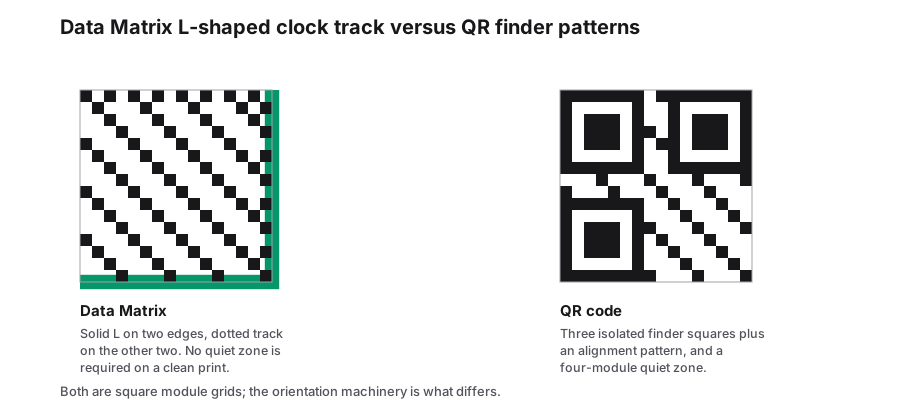
| Finder pattern | L-shaped clock track plus solid edge | Three square finder patterns in corners |
| Typical shape | Square or rectangular | Square |
| Data capacity | Up to roughly 1,556 alphanumeric characters (ECC 200) | Up to 7,089 characters (version 40) |
| Minimum practical print size | Around 4 mm for good industrial print | Around 10 to 15 mm for reliable phone scanning |
| Quiet zone | Small margin, often 1 module | At least 4 modules on every side |
| Rotation tolerance | Reads at almost any angle | Reads at any angle thanks to finder patterns |
| Error correction | Reed-Solomon, fixed by symbol size | Four selectable levels: L, M, Q, H |
Why Data Matrix wins in industry
Data Matrix puts more data into less area and does not need the wide quiet zone a QR code demands, which matters when the mark has to fit on a 6 mm medical vial or the flat of a machined part.
It also survives direct part marking. DPM creates dots by laser etching, dot peen or inkjet, and the resulting marks are irregular. Data Matrix tolerates that better in practice, which is why it became the default for tooling, aerospace and electronics traceability.
Why QR wins with people
The three finder squares make QR instantly recognisable, and every phone camera on the market decodes it without a separate app. Consumers do not need to know what they are scanning.
QR also gives you a visible dial for durability: choose level H when you want the code to survive a logo overlay or rough handling. Data Matrix error correction is fixed by the symbol size rather than chosen by you.
Scanning behaviour to plan for
- Industrial fixed-mount imagers read both symbologies, but a phone camera is optimised for QR and may take longer on a very small Data Matrix.
- Do not print both codes at the same spot expecting one scan: some cameras pick the wrong symbol, and staff end up guessing.
- If a mixed audience must be served, put a Data Matrix for the warehouse and a separate, clearly labelled QR for customers rather than one code doing two jobs.
Verification, whichever you pick
In regulated or logistics contexts, verify the printed mark against the relevant grade rather than trusting a single phone scan. Phone cameras are forgiving; a production line reader with a pass/fail threshold is the real test.
Generate at final size, print on the real substrate and read with the real device before committing to a run.
Frequently Asked Questions
Can a QR code replace a Data Matrix on parts?
Only if the marking area, quiet zone and reader all support it. On very small marks a QR code usually cannot hold enough data at a readable size, which is exactly the case Data Matrix was designed for.
Which holds more data in a given area?
Data Matrix packs more into a small space because it needs no wide quiet zone and uses a compact finder structure. QR offers higher absolute capacity at the largest versions.
Do customers need a special app for Data Matrix?
Most current phone cameras can read Data Matrix, but support is uneven across models and ages. For a consumer touchpoint, use QR.
Which is standard for GS1 identifiers?
Data Matrix is the established symbology for GS1 digital links on items and cases, with QR used for some consumer-facing applications. Follow your trading partners specification rather than choosing for convenience.
Sources & further reading
About the author — PureTools Editorial Team
Reviewed against GS1 and ISO symbology specs
Barcode and 2D code pages are reviewed against the GS1 General Specifications and the ISO/IEC bar code symbol standards, then re-checked when a specification is revised.
Editorial policy and corrections