How to use the 2 of 5 Interleaved generator
- 1
Count your digits
Type the number. Odd-length input is refused rather than padded, so if your value has seven digits, decide where the leading zero belongs and type it yourself.
- 2
Size the bars
Set the narrow bar width and the height for the space available. ITF is compact for numeric data, but a long pallet code still needs room for its pairs.
- 3
Download and confirm
Export SVG or PDF for the label printer, or PNG for paperwork. Have the reader verify the whole digit string, not just a prefix of it.
Features
- Digits only, in an even count, validated as you type
- Pairs interleaved: five bars carry one digit, five gaps the next
- No check digit invented, because the symbology defines none
- Adjustable narrow-bar width, height, colours and printed number
- Vector SVG plus PNG and PDF output, rendered on your own machine
Reading the name Interleaved 2 of 5
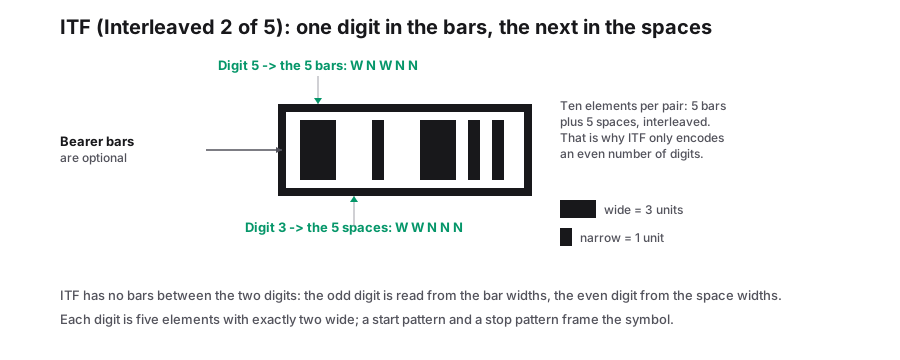
Interleaved 2 of 5 descends from the uniform symbology specification family of numeric codes, and its name is a literal description of the layout. Each digit is five elements, two of them printed wide. In a plain 2 of 5 code those digits sit side by side with a gap between them; ITF reclaims that wasted gap by interleaving, so the bars of the symbol spell the first digit of a pair and the spaces spell the second.
Two digits therefore share one block of ten elements, and that is exactly why the digit count has to be even. There is no such thing as half a pair in an interleaved symbol, so this page rejects a value of seven or eleven digits instead of quietly padding it. Prefixing a zero is the normal fix, and most ITF installations standardise on a fixed, even field length precisely so the question never comes up.
Density is the reason people stay with it. Because the gaps are doing work rather than separating characters, an interleaved pair costs about ten modules, so a ten-digit batch number that would sprawl in a character-per-block format fits on a small ticket. The cost of that economy is strictness: the reader has to stay aligned with the pair boundaries from the first element to the last, which is why a smudged or chopped end shows up as a complete failure to read rather than as one wrong digit.
How the validator treats your input
Nothing here is silently corrected. Padding, stripping or substituting a character would change the number your warehouse system is looking for, so the preview reports the problem and leaves the decision to you.
| You type | Result |
|---|---|
| 12345678 | Encoded as four interleaved pairs |
| 1234567 | Refused - odd count; add a leading zero |
| 12A45678 | Refused - the symbology is numeric only |
| Nothing | No symbol drawn; the box stays empty |
ITF and ITF-14 are different jobs
The most common mix-up is between plain ITF and ITF-14. ITF-14 uses this same interleaved encoding but carries a fourteen-digit GTIN, in which the last digit is a modulo-10 check calculated over the thirteen before it, and it is printed inside bearer bars at a defined X-dimension on corrugated cases. When a customer asks for a barcode on the outside of a shipping carton they nearly always mean ITF-14, not the bare symbology you are building here.
Neither ITF page in this studio draws bearer bars, so the frame comes from the carton artwork on top of the file you download here. What plain ITF is genuinely good for is everything your own system numbers: batch codes, bin and location tags, pallet identifiers returned to you by a captive fleet of readers.
| Interleaved 2 of 5 (this page) | ITF-14 | |
|---|---|---|
| Data | Any even number of digits | A 14-digit GTIN |
| Check digit | None defined by the symbology | Modulo 10, built into the 14 |
| Bearer bars | Not offered here | Expected on cardboard |
| Typical use | Internal batch, bin and pallet numbers | Outer cases in a supply chain |
| Retail checkout | No | No - that is EAN-13 or UPC-A |
Length, printing and the scanner settings
With no checksum in the symbology, a misprint or a partial read can turn into a different number rather than a failed scan. Sites handle that by constraining the reader instead of the label: a scanner set to accept only ten-digit ITF refuses everything else, and that refusal is the protection. So keep every ITF value in one system to the same digit count, and write that count into the reader configuration.
Fixed field length also settles the leading-zero question before it becomes an argument. If the numbering scheme says ten digits, a value that comes out of your software as 1234567 has to be padded to 001234567, and it has to be padded in the database rather than on the label - otherwise the printed symbol and the stored record disagree, and the mismatch surfaces at the worst possible moment during a stock count.
- Choose the X-dimension - the narrowest element - first; wide elements run roughly two to three times it and the reader must expect the same ratio range.
- Give both ends of the symbol clear space; the margin control supplies background, but the reader specification sets how much is enough.
- Interleaved 2 of 5 is often switched off in newer reader firmware, so a code that "will not scan" is usually a settings problem before a print problem.
- Print one label, scan it, and check the full returned string against what you typed before committing a run.
Frequently Asked Questions
Why will it not accept an odd number of digits?
Interleaving consumes digits two at a time, bars for the first and gaps for the second, so a lone final digit has no pattern to print. Add a leading zero, and store the padded form as the value your system recognises.
Does Interleaved 2 of 5 have a check digit?
The symbology does not define one and this generator does not invent one. ITF-14 is the version that layers a GTIN-14 with a modulo-10 check digit over the same encoding. Some private ITF schemes append their own check digit as part of the data; if yours does, type it as the final digit here.
Can I use this barcode on a product for shops?
No. Till scanners expect EAN-13 or UPC-A numbers issued through GS1, and Interleaved 2 of 5 cannot carry either, whatever digits you put in. It is for numbers that stay inside your own operation.
Can it hold letters?
Digits only. Alphanumeric 2 of 5 variants exist but are a different symbology that this page does not render; when the value has letters, Code 39 or Code 128 is the practical choice.
Related generators
- ITF-14 Barcode Generator for Cartons and Outer CasesMake the 14-digit GTIN barcodes printed on corrugated cases and shipping cartons, with the modulo-10 check digit verified before you send artwork.
- Code 128 Barcode Generator for Labels and InventoryThe most versatile linear barcode. Encode SKUs, serial numbers and tracking IDs with letters, digits and punctuation, then download sharp label artwork.
- EAN-13 Barcode Generator for Retail ProductsType your 12-digit GTIN and the check digit is calculated for you. Download crisp EAN-13 artwork for packaging, labels and marketplace listings.
- Create Linear Barcodes Online in Every Common FormatPick a symbology, type your value and download a print-ready barcode in seconds. Code 128, EAN-13, UPC-A, Code 39, Code 93, ITF, MSI, ITF-14, Codabar and Pharmacode are all in one studio.