How to use the PDF417 generator
- 1
Enter the record
Paste the text or structured data. PDF417 handles long values such as full names, addresses and reference numbers.
- 2
Scale for the space
Raise the scale for the print size. PDF417 is wider than it is tall, so check it fits your card or document area.
- 3
Download
Export SVG or PDF for print layouts, or PNG for digital documents.
Features
- Stacked linear format that holds up to about 1,800 characters
- Reed-Solomon error correction for damaged or worn prints
- Wide, short shape that fits on cards and document margins
- SVG, PNG and PDF export with custom scale and colors
- Generated in your browser, so personal data is not uploaded
What PDF417 is
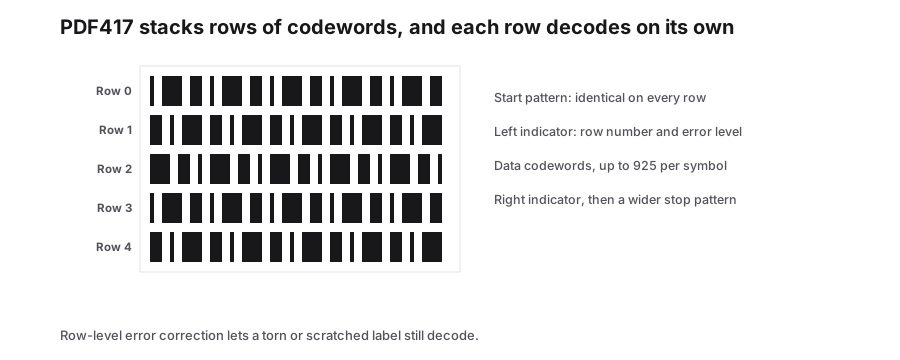
PDF417 stands for Portable Data File. Each codeword is made of 4 bars and 4 spaces spread over 17 modules, which gives the format its name. Rows of codewords are stacked on top of each other, between start and stop patterns, to form a rectangular symbol that can hold far more data than any linear barcode.
It was introduced by Symbol Technologies in 1991 and standardised as ISO/IEC 15438. Because each row looks like a short linear barcode, it can be read by laser and linear imagers as well as camera-based scanners.
Common PDF417 applications
| Application | What is encoded |
|---|---|
| US and Canadian driver licenses (AAMVA) | Name, address, date of birth, license number |
| Airline boarding passes (IATA BCBP) | Passenger name, flight, seat, booking reference |
| Shipping and freight documents | Consignment details and addresses |
| Government and tax forms | Form data for fast data entry |
Best practices
- Keep a quiet zone of at least two modules on all sides.
- Higher error correction levels add rows, making the symbol larger but more robust.
- Do not use generated codes to imitate official ID or travel documents. Those must follow the issuing authority specification.
- If the data is a URL for phones, a QR code is a better choice because phone cameras read it natively.
Sizing a PDF417 symbol
PDF417 is a stacked symbology: data runs along a row, the row closes, and the next one starts underneath. You decide the row and column count and the payload fills them. More rows give a taller, narrower footprint that suits a label; more columns give a flatter symbol that suits the wide blank area of a document.
Each row carries its own Reed-Solomon redundancy, and the level is selectable from 0 upwards. The higher levels spend a large share of the symbol on recovery, which is exactly what a form that will be folded, photocopied or handled by hand needs. Set the level from the damage you expect, not from the smallest symbol you can achieve.
| Property | Typical value |
|---|---|
| Data codewords | Up to 925 per symbol |
| Rows | 3 to 99 |
| Columns | 1 to 30 |
| Error correction | Levels 0 to 8, selected per symbol |
| Best shape | Taller stacks for labels, flatter for forms |
Frequently Asked Questions
How much data can PDF417 hold?
About 1,850 text characters, 2,710 digits or 1,108 bytes in a single symbol. Very large symbols are hard to scan, so keep the data as short as practical.
Can phones scan PDF417?
Many scanner apps and some phone cameras read PDF417, but support varies. Dedicated imagers used by airlines, police and retailers read it reliably.
Can I make a driver license barcode here?
You can encode any text as PDF417, but official ID barcodes follow the AAMVA specification and may only be produced by the issuing authority. Use this tool for legitimate documents and tickets of your own.
What is Truncated PDF417?
A variant that keeps the same data but drops the indicator columns at each side, producing a much narrower symbol. It has to be configured in the reader, so you will meet it in space-limited applications rather than in general document work.
Related generators
- Create 2D Barcodes: Data Matrix, Aztec, PDF417, DotCode and Micro QROne studio for the two-dimensional symbologies used on packaging, parts, labels and tickets. Pick a format, enter your data and download print-ready files in seconds.
- Aztec Code Generator for Tickets and Mobile PassesCreate Aztec codes, the 2D format railways and airlines use on tickets. They read well from phone screens and need no blank margin around them.
- Data Matrix Code Generator for Parts, Pharma and LabelsEncode serial numbers, URLs and GS1 data in a tiny square that stays readable even when partly damaged. Download vector files for marking and printing.
- Bulk 2D Barcode Generator from a SpreadsheetOne column of values in, a folder of labelled 2D symbols out. Mix Data Matrix, Aztec, PDF417, Micro QR and DotCode in the same run.