QR Code Size Guide: How Big Should Your QR Code Be?
A QR code should be at least 2 × 2 cm (0.8 inch) for close-range scanning, and roughly one tenth of the scanning distance for anything further away. Shorter content, a clear margin and strong contrast all let you print smaller.
By PureTools Editorial TeamUpdated 6 min read
The 10:1 rule of thumb
The most useful rule for QR code size is the distance ratio: the code should be about one tenth as wide as the distance it will be scanned from. A code scanned from 1 metre away should be about 10 cm wide. A code on a poster across a platform, scanned from 5 metres, needs to be about 50 cm wide.
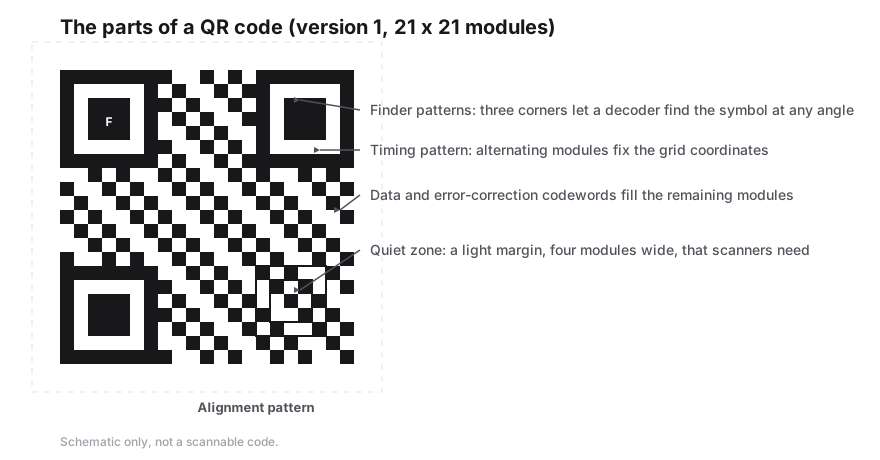
The rule assumes a simple code with a short URL. Dense codes with more content need extra size, because each module (the small squares) gets smaller as the code holds more data.
Recommended sizes by use
| Placement | Typical scan distance | Minimum size |
|---|---|---|
| Business card | 10-20 cm | 2 × 2 cm (0.8 in) |
| Product packaging | 15-30 cm | 2.5 × 2.5 cm (1 in) |
| Table tent or menu | 30-50 cm | 3-5 cm (1.2-2 in) |
| Flyer or brochure | 20-40 cm | 3 × 3 cm (1.2 in) |
| Poster (A3/A2) | 1-2 m | 10-20 cm (4-8 in) |
| Shop window | 1-3 m | 15-30 cm (6-12 in) |
| Billboard or banner | 5-10 m+ | 50 cm-1 m+ (20-40 in) |
Why content length changes the size
A QR code holding a short URL might be 25 × 25 modules. The same code holding a long URL with tracking parameters might be 49 × 49. Printed at the same width, each module in the second code is about half the size, which makes it harder for a phone camera to resolve.
If you must print small, shorten the content first. Point at a short landing-page path instead of a long URL with tracking parameters, and pick a lower error correction level when you are not placing a logo on the code. A Micro QR or a Data Matrix holds the same data in less space when you are really tight on size.
Other factors that affect scanning
- Quiet zone: keep a blank margin of at least 4 modules around the code. Cropping it is a common cause of failed scans.
- Contrast: dark modules on a light background. Inverted (light on dark) codes are not read by every scanner.
- Surface: avoid curved, glossy or textured surfaces. Glare and curvature distort the grid.
- Logos: a centre logo needs error correction level Q or H and should cover no more than about 20-25 percent of the code.
- Lighting: codes in dim places like bars and restaurants benefit from a larger size and matte printing.
Choosing the export resolution
For print, export SVG or PDF. These are vector formats that stay sharp at any size, so the printer can scale them to a billboard or a sticker without blurring. If you must use PNG, make it large enough for 300 DPI at the final print size: a 5 cm code needs about 600 × 600 pixels, and a 20 cm code about 2,400 × 2,400 pixels.
For screens such as websites, presentations and emails, a PNG of 512 to 1024 pixels is plenty. Always test the final printed piece with a few different phones before a full print run.
Frequently Asked Questions
What is the smallest QR code size that will scan?
Around 1.5 to 2 cm (0.6 to 0.8 inch) for a simple code with a short URL, scanned from close up with a modern phone. Below that, reliability drops quickly. Micro QR codes can be smaller but are not read by phone cameras.
How big should a QR code be on a business card?
At least 2 × 2 cm (0.8 inch), with a clear margin around it. Use a short URL or a vCard with only essential fields to keep the code simple.
Is there a maximum QR code size?
No. Vector exports scale to any size. The only limit is that people must be able to fit the code in their camera frame from where they stand.
Should I use PNG or SVG for printing?
SVG or PDF. Vector files keep every module edge sharp at any size. PNG is fine for screens and for print only if exported at high resolution.
Sources & further reading
About the author — PureTools Editorial Team
QR and barcode documentation
The PureTools team writes and maintains the guides on this site. Every page is checked against the published symbology specifications before it is updated, and corrections are welcome by email.
Editorial policy and corrections